Tank You for Asking

IMG_0217
Blue Tanks are LP Steel 72’s, Yellow tanks are AL 80’s 50’s & 65’s

Scuba tanks while a very important piece of equipment are often under appreciated.  While many divers are taught about tanks in their open water certification the role of a tank is left as the container of air.  But in many cases the choice of tank can be as important as choice of BCD or fins.  For most divers tanks are something that they might not normally think about, you travel to your destination and the shop provides tanks for you.  Some divers might be surprised to find out that there is as much variety in tanks as most other pieces of scuba equipment.

IMG_0213
Aluminum Tanks, AL50, AL65, AL70, AL 80

Many divers are unaware of the effects of tank choice has on our diving especially buoyancy and time.  Tanks come in a variety of sizes, the size of the take is determined by the volume of air that it is able to hold.  A common tank size is 80 cubic feet, but these sizes can vary from as small as 6 cubic feet for a backup pony bottle to as large as 149 cubic foot high pressure tank.  It is pretty obvious that the larger tanks will hold more air than the smaller if they are filled to the same pressure, but with the use of different metals and high and low pressure tanks this can also vary.  For the most part Aluminum tanks despite the size will be filled to 3000psi, steel tanks on the other hand have a fair amount of variance.  Low pressure steel tanks are exactly what they sound like they are rated for a lower pressure, depending on the tank it can range from 1800psi to 2600psi.  High pressure tanks (commonly using a DIN valve) fill on average to 3445psi, which is higher than the standard 3000psi of aluminum tanks.  What this means is that tanks that fill to higher pressure have more air packed into them than tanks that are the same size that till to a lower pressure.  So by choosing tanks that are larger and fill to a higher pressure (my favorite is HP80) you can increase your dive time compared to a smaller tank.
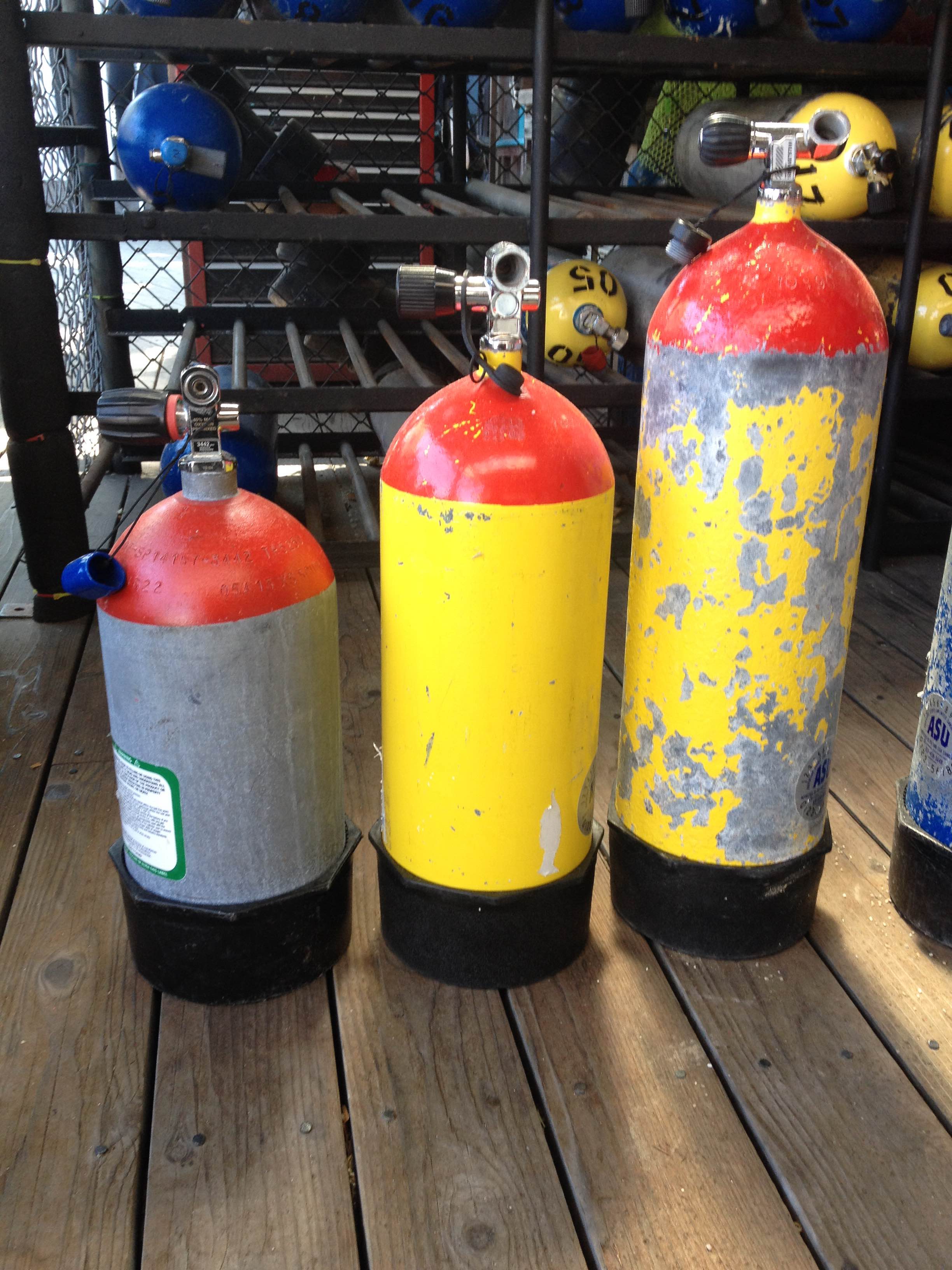
IMG_0215
High Pressure tanks with DIN valves, left to right HP 65 (with Yoke Insert), HP 80, HP 100

While size of tank might be an obvious way to increase dive time, tanks also greatly influence our buoyancy underwater.  With different choices of metal aluminum being a weaker metal and steel being a stronger metal these weights contribute to our buoyancy underwater.  Although aluminum is a lighter metal because it is weaker the walls of the tanks are much thicker.  This does usually give tanks a greater overall weight when full, when the tank is emptied the is a drastic swing in its buoyancy characteristics.  Aluminum tanks while they may vary slightly from manufacturer generally are about 4 lbs positively buoyant when empty or near empty.  This means you will be lighter at the end of the dive making it more difficult to complete a safety stop.  On the other hand while steel tanks are a stronger metal they don’t require as thick of walls and on average may be 1 lb positively buoyant to 2 lbs negatively buoyant depending on the manufacturer.  This means with a steel tank that might be 3 to 4 pounds less lead you will have to add to your weights.  The high pressure steel tanks can even be up to 4 lbs negatively buoyant when empty.

So weather or not you are buying a tank or renting a tank it is important to know how it is going to affect your dive, weather its is going to affect the duration or your buoyancy.  Be prepared to make adjustments as necessary.  If your unsure talk to the dive professionals to find out the buoyancy characteristics, and don’t forget to record in your logbook, your weights with each type of tank you use so you never have to second guess again.

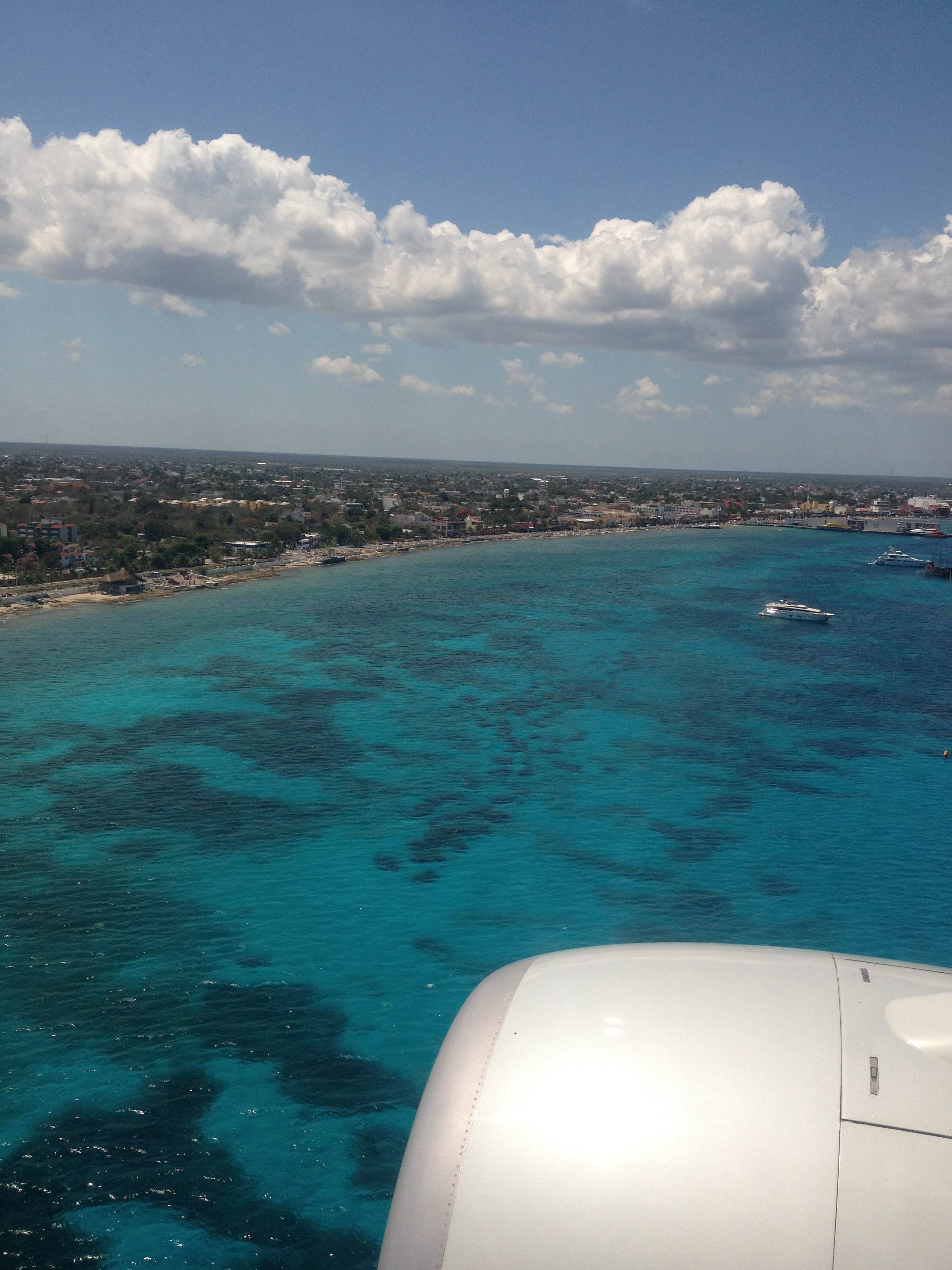
No Gloves & No Knives: Welcome to Cozumel

April 4th through 12th I was lucky enough to spend in the beautiful Cozumel Mexico.

IMG_0172Now Cozumel is one of those dive destinations that almost all divers have heard of, if is famous for its walls that reach extreme depths down to 6000 ft, and of course the drift diving.  For those that are not familiar with Cozumel it is an island off the coast of Cancun and Playa Del Carmen, it is well known for the stronger than average currents that whist divers gently over the reef.  Cozumel has an abundance of fish and creatures to see and on this particular trip there were no shortage of turtles, a common favorite among divers.  The crystal blue water makes it deceptively simple to wonder a little farther from your group and need to play catch up.  Truly a divers paradise.

IMG_0181The Highs: For me being a cold water diver the temperatures in Cozumel were a breath of fresh air, fairly consistently 79 degrees Fahrenheit.  The currents made it possible to average hour long dives full of reef structures teaming with life from the smallest corals to some of the most massive groupers.  We were fortunate enough as a group to have guides that did their best to ensure we were not in the hoard of cruz ship divers.  The walls that seemed to reach into the depths of the earth along the walls provided a ever deepening blue.

The Lows: In reality these tend to get a little nit picky because the trip was amazing, but some of this will help prepare divers for going to Cozumel in the future.  First of all Cozumel made up of primarily marine protected area, this means that there are strict guidelines on diving.  Some of these strict rules include no gloves or knives.  The concept of no gloves is relatively common and is used as a deterrent from touching the reef, but the no knives was new to me and i could’t quite understand why.  Cruz ships are also a common sight while in Cozumel, and we were told by some of the instructors that during the busy season there can be up to 12 cruz ships in a day.  what this means is there is an overcrowding of the reefs, manny divers and also the possibility of less skilled divers affecting the visibility through poor buoyancy control.  This large number of divers also makes it difficult at times to keep track of your group during the IMG_0190dive.

Overall Cozumel is a phenomenal destination for diving that all divers should have on there list of must visit locations.  Not only is there amazing visibility, cool swim throughs, walls, and a variety of aquatic life to see.  There is drift diving which can be a game changer, bottom time is increased because of the reduction of effort to move through the water and hour long dives can be easily achieved for those who have good air consumption.

Scubapro Knighthawk BC Review

PIC_0075The Scubapro Knighthawk has been my go to BCD many years, I purchased it before I started my IDC in 2011 and it has accompanied me for many dives.  The Knighthawk was the first back in flat ion BCD that I have owned, and it was responsible for a complete change in my perception of BCD’s.  The Knighthawk had many features that I think made it a very great BCD, but over time and with exposure to other brands I began to see some of its shortcomings.

The Good: One of the features that I really enjoyed about the Knighthawk was that all of the straps and fast tech buckles tightened from one side making it easy to synch down everything at the beginning of the dive. It also had a metal cam buckle for the tank strap that if you were consistently diving the same size tank made set up fast and easy.  The bladder on this BCD was huge, I had a medium and the lift capacity was 44 lbs.  It had a padded neck and plenty of D-rings for accessories.  I enjoyed this BC a lot and I found it suitable for cold water diving and warm water diving.

The Bad: There were a few things that I began to realize over time with this BCD that I wish could be a little different.  The quick release weight pockets felt overly secure and difficult to remove in knighthawk-300x300an emergency, (obviously I wanted them to be secure, but in training new students on how to remove weights I always had to cheat a bit and actually unclip the buckles instead of just pulling the pockets out).  Another issue I ran into was the deflator purge valve getting stuck open on giant stride entries, because it is a little switch that can be manipulated with the hand I could quickly fix it after i was aware of the situation, but not ideal.  The auxiliary shoulder dump would often get stuck under the shoulder strap and was rather uncomfortable when it did happen.  One of my last gripes with the Knighthawk was that the bladder while large was not well secured, it has elastic lashing around the edges to keep the air distribution even but it is a single piece of elastic for both sides so it also shifts and I found it prone to collecting air on one side.  The pockets at the base of the weight pockets are also worthless, hard to fit a pocket mask or anything for that matter and very inconvenient to access during a dive especially in gloves.

Things I’m not sure about: The Scubapro lifetime warranty.  When I bought this bcd in 2011 before I started my IDC program one of the selling points was that there was a lifetime warrantee.  Over the years with an abundance of use teaching in the pool and ocean the BCD had begun to deteriorate, despite regular washing and rinsing.  When one of the velcro pieces broke at the base of the base plate and the pad had begun to swing when I dove, I decided to take advantage of the lifetime warrantee.  I jumped through the hoops of finding my receipt 3 years later and sent it in for repair.  When the BCD had returned it came with a $25 dollar fee, not huge but shouldn’t the warrantee have covered that, or did I just miss understand the guidelines of a lifetime warrantee.

Overall this bcd served it purpose, but like any piece of equipment its hard to get every feature you want in one.  Would I buy another Knighthawk, maybe in the future when the design changes a little, but I believe there are better BCD’s out there at the moment. That are a little less expensive and have more features.

The Knighthawk bcd is to be discontinued, scubapro is currently in the process of phasing out the nighthawk and plans to replace it with the Seahawk bcd.  The Seahawk has many similar features of the nighthawk but also has larger pockets for storage.

Tips for Diving with a Mustache

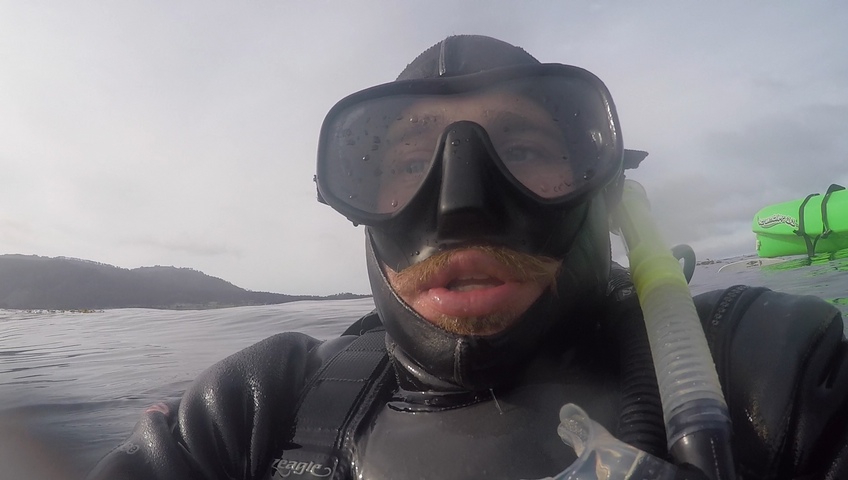
A moustache or any facial hair can be a serious problem if you are a diver.  The problem generally lies with the sealing of a mask to the face.  Now if you are a person that believes shaving is absolutely not an option then there are a couple tips for diving with a mustache.

Divers Cut:  The divers cut is a simple solution of shaving the top 8th of the mustache under the nose in order to give the mask some skin to seal agains.  Because this is a way to trim the mustache unfortunately this look does not suit every diver, but it is a good solution for a leaky mask when you have a mustache.

Scuba Surface 2Chapstick, Vaseline, Silicone: For those that are unwilling to trim their mustache and sport the divers cut, this is another option.  All of these are viable options for getting a mask to seal, they will generally leave a residue on the mask and mustache after the dive.  Some divers claim that some of these options can degrade the silicone but i have been unable to find any evidence of this.  This option does work as well as the divers cut but requires a diver to remember to bring their chosen mustache sealant. Note: if you do choose to use silicone my recommendation is silicone grease used for diving related lubrication.  Most divers will have some in their save a dive kit.

O Natural:  This is probably the least appealing option, fortunately there is a natural way our body can help us remedy a leaky mask.  Im sure all divers have experienced the accumulation of snot at the end of the dive.  This is my solution for diving with a mustache.  This remedy does not solve the problem immediately and your mask will leak for the first part of the dive but once the snot builds up a bit it will seal like there is no mustache at all.  Some people do find this the most unappealing solution, but every diver comes up with mucus on their face so why not use it, and you never have to remember to bring it with you.

In conclusion there is no reason to sacrifice a well established mustache for diving, there are many solutions to ensure a well sealed mask when sporting a mustache.


The Colder the Better

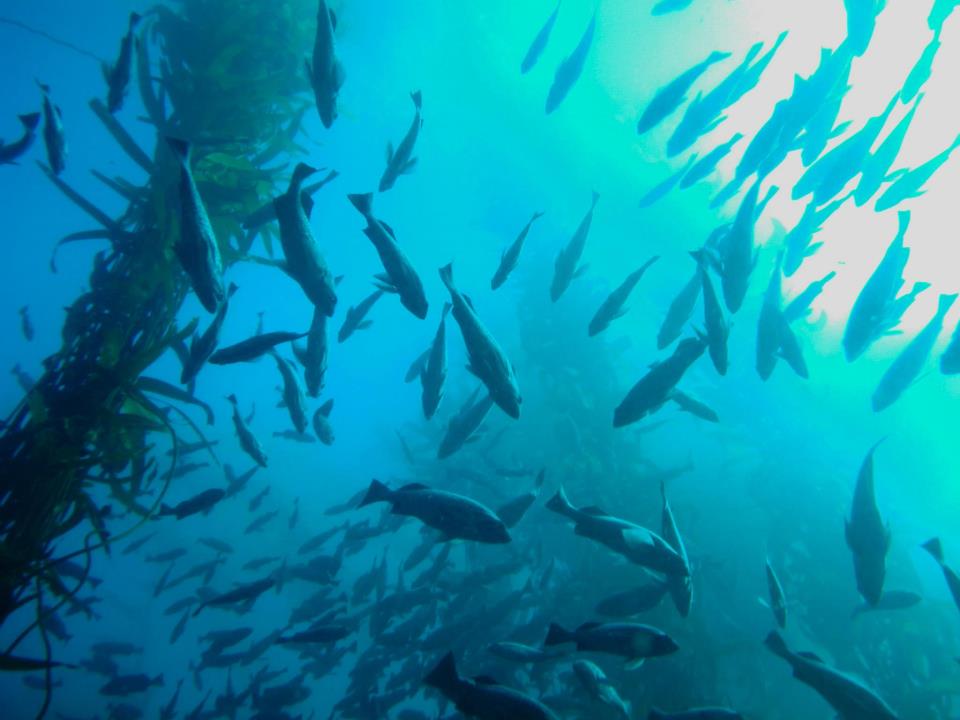
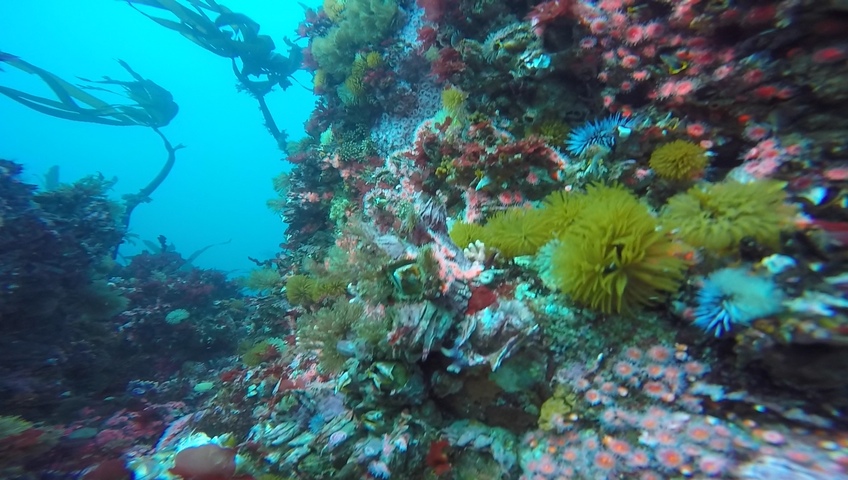
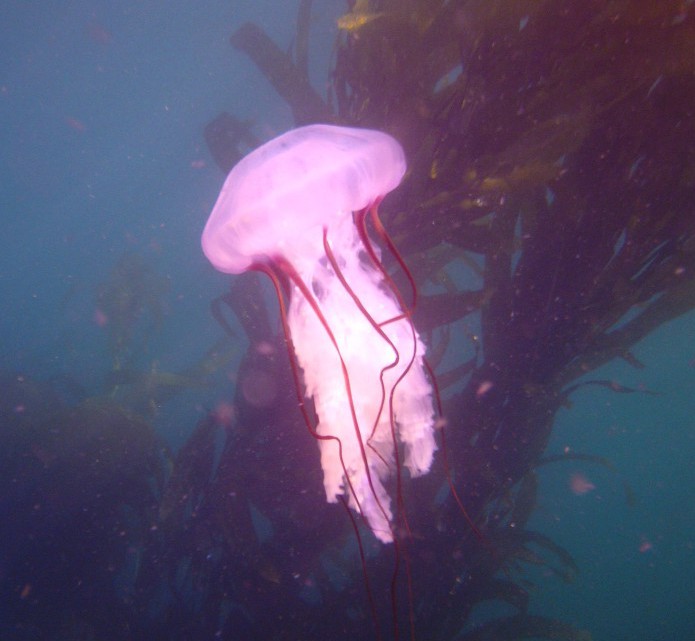
Central California diving is coveted as some of the best cold water diving in the world.  The kelp forest provide a unique environment that can only be found in California.  Diving in the kelp forest should be in every divers bucket list, and while many divers will make the trip to monterey and dive Breakwater, my suggestion is to head a little further south to Carmel.  Carmel is not as frequently dived and the structure that can be found on many dive sites is unparalleled.  monolobo #3With all of this being said there are a few misconceptions people have about diving in California.  First California diving is completely different from diving anywhere else in the world.  If you are not familiar with Monterey or Carmel I highly recommend hiring a guide they will help with gear and help you find the little treasures that hide in all the different nooks and crannies.  Second, the summer is the worst time to dive,  because of plankton blooms in the summer visibility degrades in the summer, the swells tend to be much lighter in the summer but this lack of movement allows the water to become stagnant.  Third, the water is cold no matter the time of year, average yearly highs in Monterey are in the mid 50’s while Lows are in the mid 40’s, average temperature is 50 degrees.  The best time to dive California is in the winter and spring, winter storms wash out all the junk that collects during the fall.  Cold water is also a sign of upwelling, meaning that cold very clear water is coming up from deeper waters to replace surface waters displaced by winds.  Upwelling normally occurs in the winter and spring along the California coast.  The divers that are well prepared (usually the drysuit divers) are able to capitalize on PIC_0101these cold waters and on occasion find visibility of 60-150 ft.  While many divers who are used to warm water and consistent visibility this may not sound amazing, but along the coast average visibility is about 20ft and can be as bad as 2 ft at times.  So when reports of 100ft visibility are heard it is not uncommon to see divers flood the waters.  So when you hear that the water temp is reaching its seasonal low its time to pick up your gear and get in the water.

The Art of Kayak Diving

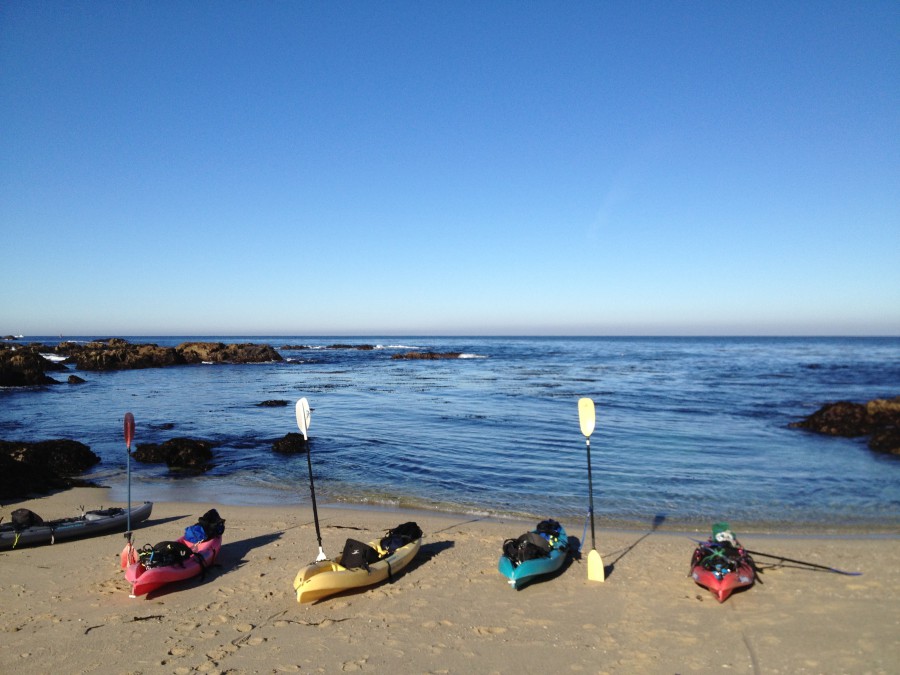
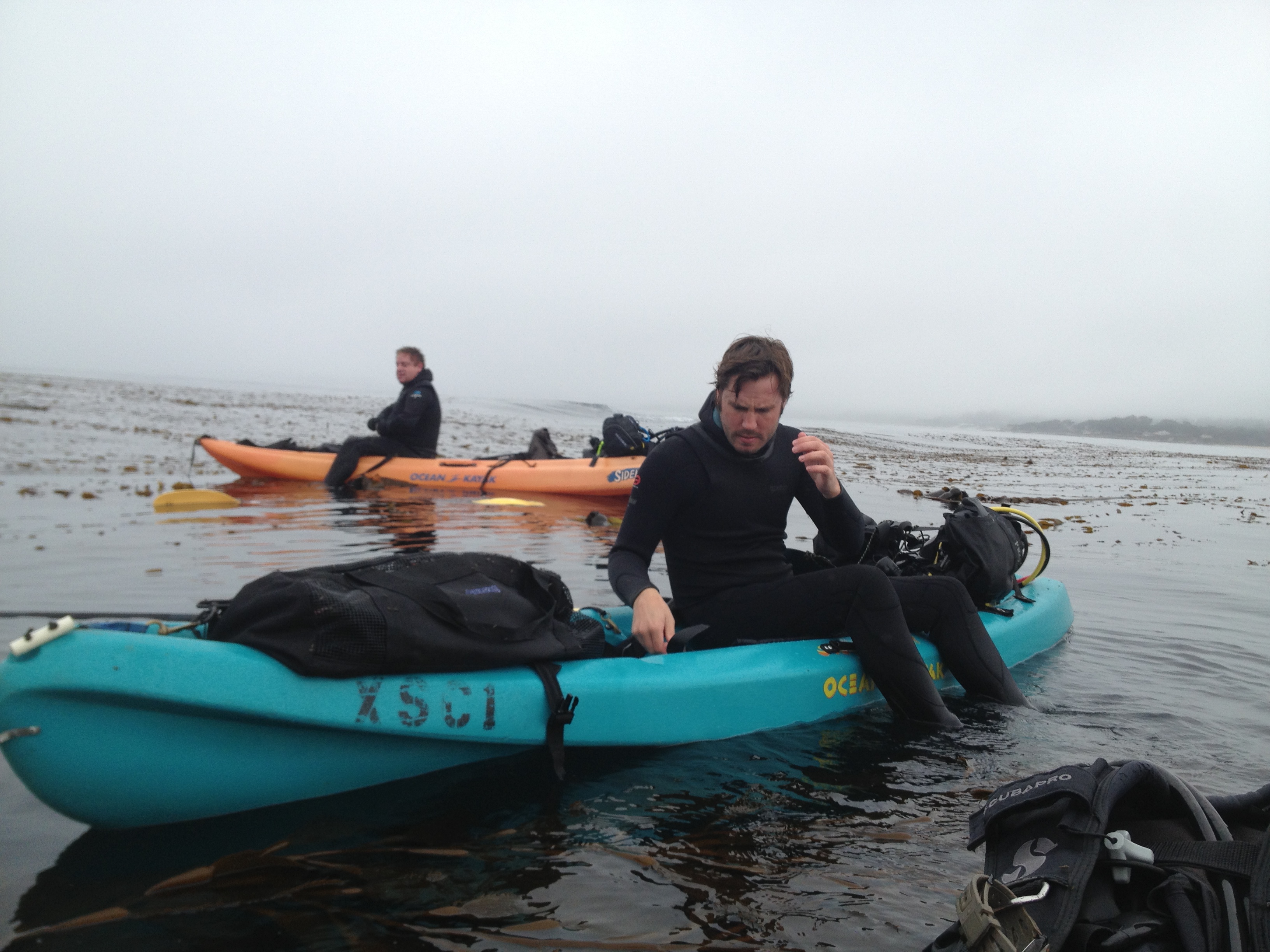
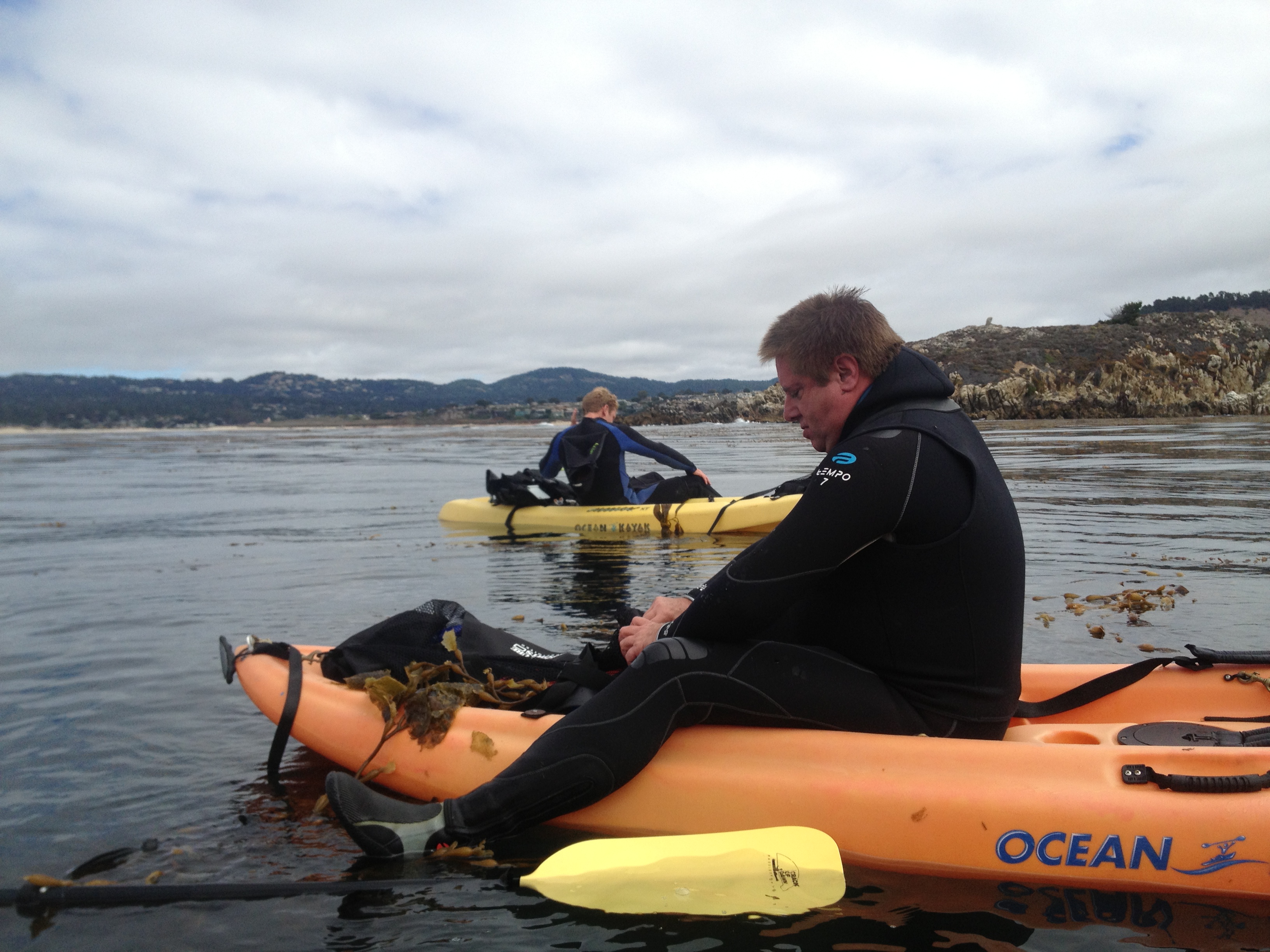
Kayak diving to many divers is an unknown term.  For most divers there are only two types of diving shore and boat, but there is a new type of diving that provides the benefits of both in one great package.  My introduction to kayak diving began with my employment at Adventure Sports Unlimited in Santa Cruz.  With the California coast being renowned for its amazing kelp diving there is a small issue of access.  A majority of the best diving is right off the shore which is accessible for divers willing to swim out but would require lengthy swims.  Of course boats can also access these IMG_0499locations but they require long motors to many of them that require calm conditions to make it around point pinos.  Kayaks solve both of these problems they are easily transported to the nearest beach, and allow for easy transport from the beach to the site.  Some might wonder what to do with all of the equipment and when do you put it on?  The kayaks used by Adventure Sports Unlimited are sit on top kayaks and are specially outfitted with extra straps to accommodate all the equipment.  All the diver has to wear is his or her wet/dry suit and booties, everything else is attached to the kayak in case of capsizing.  Currently Adventure Sports Unlimited is the only shop using kayaks as a vehicle on the central coast and as far as I am aware in California as well.  they provide a safe transport to dive sites where a person does not have to worry about the treacherous entry and exit, or the fatigue of swimming to sites that are farther from shore.  Being able to move so far offshore gives the convenience of a dive boat without the cost and hassle.  Like diving, using a kayak to dive has a steep learning curve, balance can be an issue at times as well as seasickness.  The hardest part of Kayak diving is the timing of the entries and exits, if poorly timed a kayak diver can fill equipment with sand, or lose equipment if not properly attached.  But like diving everything improves with time, IMG_0501within the last 3 years i have managed to do over 300 dives off of kayaks and I now refuse to do a shore dive without one.  I can get out to my site much faster and with less effort, and increase my dive time by starting my dive exactly where I want to instead of descending and waisting air getting to it when I am to tired of fighting with the kelp.  I hope one day that Kayak diving is more mainstream, it is fuel efficient and promotes exploring for new sites, but there are limitations that need to be addressed.  Here in Monterey and Carmel we tie our kayaks off to the kelp, many places worldwide do not have that option, so an anchor would be best suited, but what about damaging the seafloor with anchors, set up moorings.  As a final word on kayak diving they are a wonderful vehicle to access the Carmel and Monterey Bays, and I hope some time soon they will become a new standard for diving.